Deep Dive: Nokia (NOK)

NOK 0.00%↑ stock has been working really well, and I recently opened a position. I had no idea what the company does nor why it’s moving, but seeing NVDA 0.00%↑ investing in the company and a strong chart - I followed the invest and then investigate adage. I’m happy with the decisions so far, now onto the investigation part… I relied heavily on ChatGPT 5.4 - so expect a big wall of text, but it did a phenomenal job… 100x better than myself when I was an analyst drafting memos.
Nokia is emerging from a multiyear overhaul and is suddenly back on investors’ radar – a former mobile giant reinvented as a critical network infrastructure player for the AI era, now trading at bargain valuations relative to peers[1] just as new growth drivers (5G/6G, cloud, and geopolitical tailwinds) come into view. This juxtaposition of low market expectations and high strategic ambition makes Nokia particularly interesting right now.
The market has long treated Nokia as a slow-growth telecom equipment vendor – a value stock without a growth story. Its stock has been valued at a discount to peers, evidenced by a mid-teens P/E (around 13× in late 2025 versus ~27× for the industry) and a modest ~1.6× sales multiple[1][2].
This obviously reflects skepticism: investors recall past disappointments (missed technological steps, margin pressures) and a global 5G rollout that hasn’t meaningfully moved the needle. In the telecom gear space, Nokia is seen as stable but not exciting – priced more like an industrial cyclical than a tech growth play. Analyst sentiment has been mixed: as of early 2025, about half of analysts were bullish (five Strong Buys), but others remained neutral or outright bearish (e.g. Goldman Sachs slapping a “Sell” with a $3.60 target)[3]. The valuation logic embedded in Nokia’s stock is thus one of caution. The consensus story assumes low single-digit revenue growth at best (in line with tepid carrier capex trends) and only incremental margin improvement – just enough to justify the current ~20× forward P/E[4], but not a major re-rating.
In short, the market views Nokia as a “show me” story: a company valued for its solid balance sheet and steady (if unspectacular) cash flows, yet not credited with transformative growth potential.
We believe the market is underestimating Nokia’s transformation and optionality. In our view, Nokia is pivoting from a legacy telecom supplier into a broader digital infrastructure leader, and this shift could unlock faster growth and multiple expansion that consensus doesn’t yet price in. Where others see a stodgy 5G vendor, we see a refocused Nokia poised to benefit from:
The AI Network Supercycle – Nokia’s new strategy explicitly targets the explosion in cloud and AI-driven network demand[5]. As hyperscalers build out data center connectivity and enterprises adopt private 5G/edge networks, Nokia’s portfolio (from optical links to network software) is in line for secular growth beyond the traditional telco space.
Geopolitical Tailwinds – Western carriers are increasingly excluding Chinese vendors (Huawei/ZTE), which opens up market share for Nokia as a “trusted Western provider”[6]. Europe’s impending ban on Huawei in 5G could redirect an estimated €2–2.5 billion in annual network spend toward Nokia and Ericsson[7]. We think consensus underappreciates how meaningful this forced share shift could be to Nokia’s revenue over the next 2–3 years.
Self-Help and Margin Upside – Under new management, Nokia is aggressively cutting costs and streamlining its operations (merging business units, reducing overhead) to improve profitability[8]. Our variant view is that Nokia can exceed the market’s margin expectations, especially in mobile networks where even modest improvements (closer to peer levels) would significantly boost EPS.
In summary, we see Nokia’s next three years as a story of renewal: the company’s identity is shifting from “just another 5G RAN vendor” to a diversified enabler of the next-gen internet. If we’re right, Nokia’s growth, margins, and strategic positioning in 2026–2028 will surprise to the upside, challenging the current valuation framework. Consensus is anchored to Nokia’s past; our thesis focuses on Nokia’s future.
Transformation and Competitive Landscape
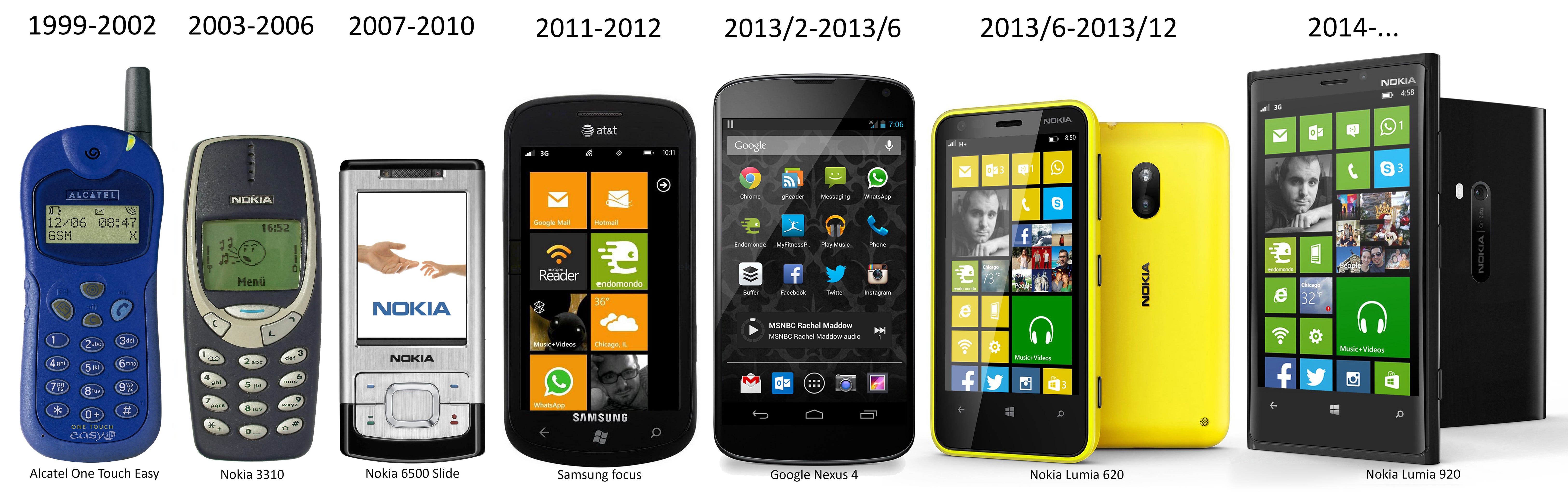
Nokia’s journey over the past decade has been one of radical transformation. After exiting the handset business in 2014, Nokia doubled down on networking through the €15.6 billion Alcatel-Lucent acquisition in 2016, inheriting assets like Bell Labs (innovation powerhouse) and expanding into IP routing and optical infrastructure. This set the stage for Nokia to offer end-to-end telecom solutions alongside its Nordic rival Ericsson and China’s Huawei. However, the road was bumpy: Nokia stumbled in the early 5G race (lagging in chip technology and losing some US market share), and by 2019–2020 it faced sagging margins and a skeptical investor base. Enter Pekka Lundmark in 2020, who rebooted strategy and R&D, and more recently Justin Hotard in 2025, an outsider from Intel’s data center division, hired specifically to orient Nokia toward the cloud/AI future[9][10]. Under Hotard’s leadership (as of April 2025), Nokia has unveiled a bold re-organization: it is collapsing its structure from four groups into two streamlined segments and prioritizing a handful of strategic areas (AI, cloud, 6G)[5][11].
Competitive landscape: Nokia operates in a highly concentrated industry. In wireless networks (RAN equipment for 4G/5G), the big three are Huawei, Ericsson, and Nokia – with Huawei historically holding the largest share globally, though now constrained by bans in the U.S., Europe and other markets for security reasons. Ericsson and Nokia have roughly split the “Western” market between them. Notably, Nokia’s mobile networks division hit a rough patch: between 2022 and 2024, overall telco spending on RAN fell sharply (a ~$10 billion drop globally)[12], and Nokia not only faced that cyclical downturn but also lost ground in North America (Nokia’s 2025 mobile networks sales were €7.8 billion, down ~4% YoY, and almost €4 billion lower than in 2019[13]). Ericsson outperformed Nokia in this period, achieving higher mobile margins (~9.6% in its networks division vs. Nokia’s scant 2.8% in 2025)[14]. Meanwhile, Huawei’s shadow looms: despite Western restrictions, Huawei and ZTE still captured perhaps 1/3 of Europe’s RAN market as of mid-decade[7]. This is why Nokia’s new CEO is openly cheering Europe’s moves to mandate a Chinese vendor ban – it directly converts into addressable market for Nokia. In a recent call, Hotard noted Huawei’s European business (in Nokia’s areas) is worth €2–2.5 billion a year, calling it a “sizeable revenue opportunity for trusted vendors”[7]. Outside of mobile radio, Nokia faces competition in specific segments: Cisco and Juniper in IP routing, Ciena (and now Nokia, via its Infinera buy) in optical transport, Samsung in certain 5G contracts, and a host of smaller players in networking software. The competitive landscape is thus a mix of established rivals (Ericsson, Cisco) and newer threats (Asian vendors, open-source and OpenRAN initiatives).
Crucially, Nokia’s transformation is about positioning itself where the industry is going, not where it has been. The company is repositioning from a legacy telecom supplier (reliant on carrier wireless upgrades) to a broader tech player supplying connectivity for cloud computing, private wireless for enterprises, and eventually 6G for everything. It’s also slimming down: headcount has dropped from ~85k in 2023 to ~75k by end of 2024 (pre-Infinera) through restructurings[15], and further consolidation of support functions is underway. In essence, Nokia is trying to become leaner and more focused just as its market opens up (Huawei’s woes) and evolves (AI networks). The context is one of a company at a strategic inflection point: pivoting to new growth areas while fighting off fierce competition in its legacy core.
The Thesis
Is Nokia a has-been value trap or a turnaround tech play? This is the crux of the investment debate. On one hand, the stock’s cheap metrics and long history of disappointments breed caution – some skeptics argue Nokia will never consistently grow and that any excitement (5G, etc.) invariably fizzles out, leaving a low-margin business. On the other hand, there is a growing counter-narrative that Nokia’s reset has fundamentally improved its prospects, and that the market hasn’t caught up yet. This tension is visible in analyst opinions: for example, after recent earnings one firm raised its target to $7 on a “Buy” citing a beat and optimism, while another concurrently downgraded to “Sell” at ~$3.60, citing concerns about the stock’s run-up and execution risks[3]. The hook for a Nokia investment is this gap between perception and reality. The market’s story is cautious, but if Nokia’s story is indeed changing (new CEO, new tech cycle, new market share opportunities), then the payoff could be significant as perceptions catch up. In practical terms, the central tension can be framed as: Is Nokia’s current low valuation an opportunity (because fundamentals will improve), or is it low for good reason? Our analysis leans toward the former – that Nokia is more phoenix than fallen angel – but recognizing that this is the key question an investor must get right. The next few quarters will likely resolve this tension, making now a critical juncture for the stock.
What They Do?
Nokia is a telecommunications and networking equipment provider, operating across four main businesses (being simplified into two segments from 2026). Let’s break them down:
Mobile Networks: This unit provides technology for radio access networks (RAN) – essentially the cell tower gear that enables 4G and 5G mobile connectivity – as well as microwave radio link equipment for wireless backhaul[16]. This has traditionally been Nokia’s largest segment by revenue, supplying mobile operators globally with base stations, antennas, and related software. Key revenue drivers here are carrier capital expenditures on wireless infrastructure (new spectrum rollouts like 5G, network expansions, etc.). In 2025, Mobile Networks sales were roughly €7.8 billion[13] (flat in constant currency after prior declines), reflecting both the maturing 5G cycle and intense competition. This segment’s performance is highly levered to market share wins (or losses) in major carrier contracts and the timing of upgrade cycles. Notably, Nokia’s mobile unit has been focused on profitability over pure growth recently – for example, it pulled back from low-margin deals (e.g., in China) to improve margins[17]. Any future 5G Advanced or 6G investment cycle (late-decade) would fall squarely here, as would new opportunities in OpenRAN.
Network Infrastructure: This segment serves a broader set of customers – telecom operators, web-scale cloud companies, large enterprises, and public sector – with Nokia’s fixed networking products. It includes Optical Networks (high-capacity transport systems, submarine cables, etc.), IP Networks (routers, switches for internet backbones and data centers), and Fixed Access (e.g. fiber broadband access equipment)[18][19]. Think of Network Infrastructure as Nokia’s “wireline” and enterprise side: from the fiber in the ground to the IP routing that directs traffic. Key revenue drivers are fiber broadband rollouts (e.g. national fiber initiatives in Europe or Openreach in the UK leveraging Nokia kit[20]), cloud & data center networking demand (hyperscalers upgrading their networks for AI workloads, where Nokia’s high-speed optical and routing gear comes in), and continued capacity upgrades by carriers on core networks. In 2025 this segment actually overtook mobile as Nokia’s largest by sales, with ~€7.6 billion in revenue[21]. It’s also where Nokia saw solid growth: for Q4 2025, Network Infrastructure sales grew 19% YoY (+7% constant currency)[22], led by surging demand in Optical Networks (+17% YoY in Q4)[23]. Simply put, this is Nokia’s growth engine currently, buoyed by the fiber and cloud boom. It’s diversified across telecom and tech customers, which helps reduce reliance on any single carrier’s spending cycle.
Cloud and Network Services (CNS): This smaller segment focuses on software and services – things like core network software (which runs carrier networks behind the scenes), cloud-native network functions, digital operations software, and enterprise solutions such as private wireless networks and IoT platforms[24]. CNS is about network intelligence and cloud delivery: for example, Nokia’s core 5G software that runs in telecom data centers, or its private 5G systems for factories and campuses. Revenue drivers include carriers upgrading to 5G core networks (many are shifting to cloud-based cores), demand for telco software delivered “as-a-Service,” and enterprise adoption of private networks. In 2025, Nokia’s CNS net sales were on the order of ~€3.3 billion (Q4 was €0.84B) and notably outperformed the market, growing 6% for the full year even as the overall telco software market shrank 2%[25]. This growth, combined with a 5 percentage-point operating margin expansion in 2025, was driven by strong uptake of cloud-native core network products[25]. In other words, Nokia is carving out a respectable niche in selling software upgrades and cloud solutions to its carrier base (and some enterprise clients), complementing its hardware segments.
Nokia Technologies: This is a unique, high-margin segment that manages Nokia’s extensive patent licensing business and other technology licensing (including brand licensing for consumer devices). Nokia has decades of R&D leadership in mobile technologies – patents essential to 2G/3G/4G/5G standards – which it licenses to handset makers and others[26]. Virtually all smartphones today use some Nokia-patented technology, generating royalty income. This segment’s revenue (about €1.4 billion annual run-rate[25]) doesn’t grow much with the cycle; it depends on renewals of license agreements (with companies like Apple, Samsung, etc.) and occasional new licensing opportunities. It’s extremely profitable – historically operating margins have been ~70%+[27] because costs are minimal (just patent management). Nokia Technologies essentially monetizes Nokia’s past innovations, providing a steady cash influx that can subsidize new R&D. In recent years this segment faced volatility (patent disputes or renewals can cause revenue to swing); in 2025 its sales dipped (Q4 down 14% YoY constant currency)[27] due to timing of contract renewals, a factor in Nokia’s overall profit decline. However, management indicates the licensing business maintains a contracted run-rate of ~€1.4B/year[25] going forward, and it remains a critical profit center for Nokia (cash from this segment helps fund the heavy R&D in other segments).
To summarize “what they do”: Nokia provides the hardware, software, and intellectual property that underpin modern communication networks. From the cell tower to the fiber backhaul, from the internet core router to the cloud software that manages the network, Nokia’s business segments collectively cover a broad swath of the networking value chain[28]. Its revenue comes mainly from selling network equipment and solutions to carriers (like Verizon, Deutsche Telekom), enterprises (for private networks), and increasingly cloud providers (for data center switching and optical interconnects), as well as from licensing fees on its patents. Each segment has distinct drivers – e.g. mobile access is driven by wireless buildout cycles; network infrastructure by broadband and cloud investments; CNS by software upgrades; and licensing by device volumes and contract renewals – giving Nokia a mix of cyclical and somewhat recurring revenue streams. This diversification across products and customers is becoming a hallmark of Nokia’s identity after its transformation.
Nokia’s Core Identity for the Next Decade
Nokia’s leadership is articulating a clear vision of what the company aspires to be in the 2025–2035 period. In a phrase: “Nokia changed the world once by connecting people – and will again by connecting intelligence.”[6] This quote from CEO Justin Hotard captures Nokia’s intended identity as the essential provider of connectivity in the age of AI and ubiquitous computing. Over the next decade, Nokia is positioning itself as the trusted Western backbone of digital infrastructure – not a consumer phone brand, but the behind-the-scenes architect of networks that connect everything from smartphones to smart cars to cloud AIs.
Concretely, Nokia’s core identity will revolve around:
Technological Leadership in Networks: Nokia aims to lead in “AI-native” networks and the coming 6G era[5]. That means networks that are not just fast pipes, but intelligent, self-optimizing systems (leveraging AI) and built to handle massive machine-type communication and immersive technologies. Nokia is pouring R&D into 6G research (its Bell Labs is deeply involved in 6G standards work) and into integrating AI throughout its product lines. The identity here is innovator in advanced network technology, akin to what Bell Labs represented in the 20th century for telecom – Nokia wants that mantle for the 21st century’s fusion of AI + connectivity.
End-to-End Infrastructure Provider: While it’s simplifying internally, Nokia externally will present itself as an end-to-end solutions provider for critical networks – spanning mobile, fixed, and cloud. It already highlights “expertise across fixed, mobile, and transport networks”[29] as a key differentiator. In the next decade, Nokia’s identity is that of a one-stop-shop for any operator or enterprise that needs to build a network – whether it’s a national 6G mobile network, a fiber-to-the-home grid, or a private industrial network. This comprehensive scope (few companies globally can match it) is central to Nokia’s value proposition and thus its identity.
“Connecting Intelligence” (Networks for AI): Perhaps the most forward-looking aspect is Nokia embracing the role of networks in the AI/cloud revolution. The company explicitly frames itself as “powering the AI supercycle”[6]. In practice, this means providing high-performance, low-latency, secure connectivity for AI workloads – for example, the optical interconnects between data centers that allow AI model training across distributed compute, or ultra-reliable low-latency links for autonomous systems. Nokia’s recent partnerships (e.g. with NVIDIA on integrating AI into 5G networks) underscore this direction[30]. The core identity becomes enabler of AI everywhere, analogous to how in the past Nokia enabled mobile phones everywhere.
Western Trust and Sovereignty: A subtler but important facet – Nokia is branding itself as the “trusted Western provider”[6] of secure connectivity. In a world where networks are seen as national security assets, Nokia (along with Ericsson) is one of the few non-Chinese, large-scale suppliers. Over the next decade, especially if geopolitical bifurcation continues, Nokia’s identity will be tied to being the go-to network supplier for democracies and companies that cannot or will not use Chinese technology. This confers a sense of responsibility and also an advantage – Nokia can play the patriot card in many markets. It’s telling that Nokia’s map of opportunity is literally color-coded by where Chinese vendors are banned vs allowed[31]; Nokia sees itself as the network partner for the “green” world (free of untrusted vendors).
Financials
As of the latest trailing twelve months (LTM, i.e. full-year 2025), Nokia’s financial profile shows modest top-line growth, pressured margins, but solid cash generation.
Key figures from the last 12 months (Q1–Q4 2025):
Revenue: €19.9 billion (≈$23.8 billion) in reported net sales[21], which was a +3% YoY increase in euro terms (+2% constant currency)[44]. This broke a downturn streak and was in line with company guidance. Growth was driven by Network Infrastructure gains and currency tailwinds, partially offset by flat-to-down mobile and licensing sales. Geographically, Nokia saw growth in regions like Europe, while North America was softer (due to prior share loss and carrier spending pause). The 2025 revenue level is still below Nokia’s 2019 revenue (~€23B), reflecting the challenges of the past few years, but the company has returned to a growth footing albeit a low one.
Margins: Nokia’s comparable gross margin in 2025 was 45.1%[45], down from 47.1% in 2024 (a 200 bps drop) due to less contribution from high-margin licensing and some pricing pressure. Comparable operating profit was €2.024 billion[46], which is a 10.2% operating margin – down from 13.4% in 2024[46]. So, operating margin contracted ~320 bps YoY. The decline is attributed to two main factors: a slump in Nokia Technologies (licensing) profits and heavy investment/R&D in Network Infrastructure for future growth (as noted by management)[47]. On a reported (IFRS) basis, operating margin was even lower at 4.4%[48] due to one-time items (restructuring charges, etc.), but for our purposes the comparable figures give the true business trend. Net profit for 2025 was €1.6 billion on a comparable basis[49] (comp EPS €0.29), but only €0.66 billion on a reported basis (EPS €0.12)[50][51] after accounting for various write-offs (discontinued operations, restructuring). The large gap between reported and comparable results indicates Nokia took substantial one-off charges in 2025 as part of its restructuring and portfolio pruning.
Cash Flow and Balance Sheet: Nokia generated €1.5 billion in free cash flow for 2025[36], which is about 72% of its comparable operating profit – a healthy conversion ratio. This FCF was after €0.6B in restructuring and lease payments, indicating the underlying cash generation is strong. Nokia’s net cash position was €3.4 billion at end of 2025[52] (gross cash ~€9B, gross debt ~€5.6B), providing a nice cushion. The company has maintained a net cash balance for several years, underpinning its financial stability (also rare in the telecom equipment peer group – Ericsson, for instance, has net debt). Capital expenditures are relatively modest (Nokia invests primarily in R&D). In 2025, R&D expense was €4.6B[53] (~23% of sales), reflecting the high engineering intensity of the business, whereas capex is only a few hundred million euros (mostly facility and IT investments). This means Nokia’s cash flow is chiefly used for R&D and working capital rather than heavy fixed-asset spending. Working capital in 2025 was a slight drag (inventory builds for supply chain resilience), but overall Nokia generated positive bookings-to-bill which helped cash.
Segment Economics: On a recast basis (aligning to the new 2026 structure), we see two core segments with distinct economics: Network Infrastructure had ~€7.65B sales in 2025 with a 10.1% operating margin[54][55]. Mobile (Infrastructure) had ~€11.41B sales with a 13.4% operating margin[56]. Network Infra’s margin dipped slightly vs 2024 due to growth investments (e.g. integration of optical assets)[57][47], while Mobile’s margin fell sharply from 17.3% to 13.4%[58] mainly because the high-margin Tech licensing within Mobile (now called Technology Standards) saw revenue drop from €1.9B to €1.5B[59]. The licensing unit remains extremely profitable (Q4 2025 Tech op margin was 65%[27]), so any swings there impact overall margins disproportionately. Cloud & Network Services (part of old reporting) improved profitability – its Q4 op margin was 28.3%, up from 23.6%[27], signaling the software business scaling well. In short, 2025’s financials depict a company with roughly flat volume, some margin compression due to a revenue mix shift away from licensing, but disciplined cost control and still-robust cash flow.
Shareholder Returns: Nokia has reinstated a dividend in recent years. For 2025, the Board is proposing a €0.14/share dividend (to be paid quarterly)[60][61], which at the current share price yields about ~2%. Nokia also has done occasional share buybacks (it completed a €300M buyback in 2022). The dividend and buyback policy is conservative, reflective of Nokia’s focus on maintaining net cash and flexibility for R&D and M&A (like the recent ~$0.9B acquisition of Infinera’s optical business).
Overall, Nokia’s LTM financial picture shows a stable top line with pockets of growth, margins that are acceptable but leaving room for improvement, and a strong financial foundation. It’s profitable (even if 2025 profits dipped YoY) and generates enough cash to invest in the business and reward shareholders. The segment breakdown highlights that the growth in Network Infrastructure and the resilience of software are helping offset challenges in mobile hardware and licensing. This baseline sets us up for the forward-looking analysis: the question is whether Nokia can reaccelerate growth and rebuild margins from this 2025 base. The resources are there (cash, technology, market access) – now it’s about execution in 2026 and beyond.
Product Mental Model
To understand Nokia’s place in the tech ecosystem, it’s useful to construct a mental model of its products: think of Nokia as building the digital highways, bridges, and tunnels that data travels on. If the internet and mobile networks are the “roads” of the digital economy, then Nokia is one of the chief suppliers of the paving material, the construction crews, and the maintenance tools for those roads.
In more concrete terms, Nokia’s products span all layers of connectivity:
At the physical layer, Nokia provides the radio antennas on cell towers, the fiber-optic lines and cables, and the routing/switching hardware in data centers and central offices. These are the tangible infrastructure elements – analogous to railroad tracks or highway asphalt in our metaphor – that carry digital signals (whether it’s your voice call, a video stream, or a cloud server query). For instance, Nokia’s massive MIMO 5G antennas enable wireless broadband in cities, and its optical DWDM systems carry internet traffic between cities at terabits per second.
At the network control layer, Nokia supplies the software that controls and optimizes those physical networks. This includes things like the 5G core network software that routes data within a telecom operator’s system, subscriber management databases, network orchestration tools, as well as newer “software-defined networking” solutions. In the mental model, this is akin to the traffic control system – the stoplights, rail switches, and traffic monitors ensuring everything flows smoothly and efficiently on the infrastructure. Nokia’s products here ensure that networks are secure, reliable, and can adapt (e.g., slicing a network for different enterprise customers, or automatically rerouting around a fiber cut).
At the edge and enterprise layer, Nokia’s offerings like private wireless networks (essentially mini 5G networks for a specific factory, port, or campus) represent the extension of digital infrastructure into specialized environments. Picture a sprawling smart factory: Nokia might provide the private 5G network that connects all the robots and sensors in real time. In our metaphor, this is like custom-built infrastructure for a private facility (like an internal logistics rail within a mine, which Nokia actually does provide private LTE for in remote mines). These products position Nokia as a partner for enterprises embarking on Industry 4.0, giving it a role beyond the telco domain.
The scope of Nokia’s role is truly end-to-end. Unlike a pure-play in one niche, Nokia can serve as the “one-stop infrastructure shop” – delivering everything from the core backbone (IP/optical) to last-mile access (mobile radios, fiber GPON) to the software brains (core network & OSS/BSS software) that manage it. A network operator could, in theory, build a complete network with mostly Nokia gear and software. That has made Nokia akin to an integrator of digital infrastructure: its portfolio is broad and integrated, emphasizing interoperability (benefiting from owning so many pieces).
So, the mental model is: Nokia is to digital connectivity what an infrastructure company is to transportation. It provides the essential equipment and know-how to build high-performance networks, which in turn enable all modern communications. In investment terms, Nokia can be thought of as a “picks and shovels” play on multiple tech trends: the 5G/6G cycle, cloud expansion, IoT proliferation, and even AI (since AI’s growth is causing a need for upgraded networks). It’s not making the shiny apps or devices; it’s making the underlying infrastructure that makes those things possible. Importantly, this infrastructure role is often characterized by high barriers to entry (you need deep R&D and proven reliability to play at this level) and long-term customer relationships. That’s an advantage Nokia holds – despite all its ups and downs, it’s still one of a tiny handful of companies on earth that nations trust to build their national networks. That quasi-utility, mission-critical role defines Nokia’s place in the digital world.
Business Model
Nokia’s business model is fundamentally about selling high-tech products (and associated services) to large organizations, backed by heavy R&D investment and a moderate asset footprint. Let’s break it down:
Revenue Model: Nokia primarily generates revenue through sales of equipment, software, and licenses to B2B customers (Communication Service Providers, enterprises, governments, and licensees). Most of its big deals are project-based or contract-based – e.g., winning a multi-year contract to supply a telecom operator’s 5G radio network, or a one-time sale of optical gear for a data center interconnect. These deals can be lumpy and negotiated, often involving competitive bids. Alongside equipment sales, Nokia earns software revenues (which can be perpetual licenses or subscriptions, and increasingly “as-a-service” models for certain offerings) and maintenance/services revenues (installing gear, optimizing networks, providing technical support). In addition, via Nokia Technologies, it has a royalty-based revenue stream: essentially collecting fees per device or per patent license agreement from third parties using its intellectual property.
The sales cycle is long and relationship-driven. Customers (especially telcos) are conservative and value reliability – Nokia often undergoes lengthy trials and RFP processes to win business. Once in, however, it tends to stay for a product generation or longer (switching network vendors can be costly for an operator, so there is a quasi-subscription aspect in practice, even if not contractual beyond each rollout). This yields a backlog and some revenue visibility. For example, if Nokia is a main 5G supplier to Deutsche Telekom, it will likely continue supplying through the 5G cycle, and maybe beyond. Nokia leverages this installed base to also sell upgrades and software updates.
Profit Drivers: Nokia’s profitability comes down to scale and mix. The gross margin on hardware can be decent (40-50% range) but not stellar, because hardware is competitive and has significant cost of goods (silicon chips, manufacturing, etc.). However, software and patents have very high gross margins. Thus, product mix is crucial: a deal heavy on services or low-end hardware might be barely breakeven, whereas a software add-on or a patent license is nearly pure profit. Nokia’s blended gross margin ~45%[45] reflects this mix of high and low margin components. To improve margin, Nokia is trying to increase software sales and also push more of its hardware to be based on proprietary chips that lower costs (thus boosting hardware margins). The patent licensing business significantly boosts overall profitability – e.g., ~7% of revenue (licensing) contributed over 20% of operating profit in 2025 (given ~70%+ margin). If that were to diminish, margins suffer, which is what happened in 2025.
On the operating level, R&D and SG&A are the big expenses. Nokia spent ~€4.6B on R&D in 2025[53] (23% of sales), which is the price of staying technologically relevant. This is essentially an investment into future products (6G, new routers, etc.), and it’s expensed through the P&L, creating a drag on current earnings but hopefully leading to better products (and hence sales/margins) down the line. Selling, General & Admin was €2.5B (12.5% of sales) on a comparable basis[53] – Nokia is working to reduce this via the segment consolidation and shared services (targeting €200M+ savings as noted). The business model thus has sizable operating leverage potential: if Nokia can grow revenue without commensurate increases in R&D/SG&A (because a lot of that cost is fixed or can be made more efficient), then margins expand. We saw an example in Cloud & Network Services: 6% sales growth plus cost discipline yielded 5 points of op margin expansion[25] – that’s operating leverage in action in a software-oriented segment.
Capital Intensity: Unlike a traditional manufacturing firm, Nokia’s business is not very capital-intensive in terms of physical assets. They do utilize contract manufacturers for a lot of hardware production, and their own factories (e.g. for certain radio products) are relatively few. CapEx is a small fraction of sales (likely <3%). Instead, intellectual capital intensity is high – the “capital” Nokia plows in is human capital (engineers) and R&D dollars. So one could say Nokia’s model is to continuously invest in R&D (like an ongoing development capex) to keep its product portfolio cutting-edge, and then monetize that via product sales and licensing. It’s a bit like a pharma model (high R&D, relatively low manufacturing cost per unit) combined with a project-engineering model.
In delivering its solutions, Nokia sometimes also provides financing to customers (vendor financing) or engages in revenue-share models for private networks, which is an aspect of the business model to facilitate sales, though it can tie up some capital or add risk. However, Nokia’s net cash position indicates it hasn’t over-leveraged itself with such financing.
Economies of Scale: Nokia benefits from scale in R&D (spreading huge development costs over many sales) and scale in procurement (buying components in bulk). The consolidation of the industry means the remaining players (Nokia, Ericsson, Huawei) have significant volume to drive down unit costs. This is why losing market share hurts margins – less scale to cover fixed costs. Nokia’s model thus heavily relies on maintaining a sufficient share in key markets so that its R&D spend pays off. It also means that adding even modest incremental revenue can disproportionately improve profit if fixed costs are covered.
Recurring vs One-Time Revenue: There is a mix. Services and maintenance contracts provide recurring revenue (often multi-year agreements for support). Software can be recurring if sold as subscriptions or through renewals of support licenses. Hardware is more one-time, but given continuous network expansion, it becomes quasi-recurring as customers keep upgrading capacity. Patent royalties are very recurring (dependent on phone shipment volumes globally, etc., and periodic renegotiation). So Nokia has a somewhat recurring revenue base, but not as high as pure software companies. About 20-30% of revenues might be considered recurring (services, support, IP royalties), with the rest more tied to equipment project cycles.
Margins & Returns: Historically, Nokia’s comparable operating margins have been in the 8–12% range in recent years (targeting 14+% long-term). This is lower than many pure tech peers (like Cisco’s 25% op margins) but typical for telco equipment given competition. Its ROIC has been mediocre, in part due to the large goodwill from past acquisitions and the R&D expense. However, the company’s strong cash conversion and asset-light nature means it can still return cash to shareholders without huge capex needs. If margins improve as planned, incremental ROIC on new investments could be attractive (they’re effectively aiming to do more with roughly the same cost base).
In essence, Nokia’s business model is high-fixed-cost, high-tech, low-variable-cost. Once a product is developed and the fixed cost sunk, selling more of it (especially software or chips) is very profitable. This is why volume and market share are vital. It’s also why the patent business is a jewel – it’s pure profit after the initial R&D that created those patents years ago.
To conclude, Nokia makes money by selling the enabling technology of connectivity, requiring it to stay at the cutting edge through heavy R&D spend. Its profits are then a function of how successfully it turns that R&D into market-leading products (to drive sales) and how efficiently it can deliver those (to protect margins). The capital intensity is more in brains and labs than in factories, which is good for flexibility but requires constant innovation to maintain. This model, if executed well, can produce a virtuous cycle (technology leadership → more sales → scale → funds more R&D → maintain leadership). If executed poorly, it can become a vicious cycle (loss of leadership → sales decline → can’t fund R&D → fall further behind). The next few years will test which path Nokia follows.
Valuation and Setup
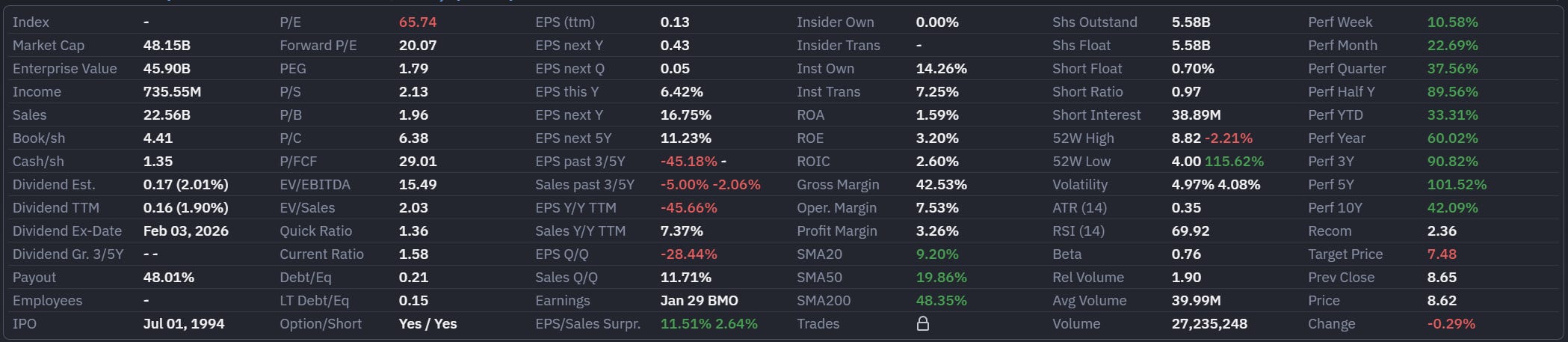
At the current market price (around $8.65 per NOK ADR, as of March 16, 2026), Nokia’s valuation appears undemanding relative to both its peers and its own history. Market capitalization is roughly $48 billion[65] (≈€44B), and enterprise value about $46 billion[66] after accounting for net cash. Key valuation metrics include:
P/E Ratio: Trailing twelve-month GAAP P/E is elevated (~66×) due to one-time charges impacting 2025 earnings[4]. On a comparable (non-IFRS) basis, using €0.29 (~$0.32) EPS, the trailing multiple is ~27×. The forward P/E (looking at 2026 consensus EPS ~$0.43) is about 20×[66]. This is roughly in line with the broader market and below pure tech peers. Notably, when Nokia was trading near $5.50 a few months ago, its forward P/E was ~13× and it was highlighted as a value outlier[1]. The stock’s rise has closed some of that gap, but Nokia still trades at a discount to the networking industry average (for context, the comm equipment industry P/E is ~25–30×[1]). This suggests the market isn’t pricing Nokia as a growth stock yet.
EV/EBITDA: Approximately 15.5× TTM EV/EBITDA[67]. Telecom gear peers often trade in the low teens EV/EBITDA, so Nokia is a tad higher, likely because its EBITDA was temporarily depressed. As margins recover, this multiple should normalize down. It’s not stretched.
Price/Sales: About 2.1× TTM sales[68]. This is still on the low side for a company with mid-single-digit growth – for example, many enterprise tech hardware firms trade at 3–5× sales, while pure software companies are much higher. Even Ericsson trades near 1.5–2× sales typically. Nokia’s P/S around 2× reflects its lower margin profile, but if margins improve, a 2× sales could prove cheap (for instance, achieving 12% op margin and a market multiple of 15× EBIT would correspond to ~1.8× sales).
Price/Book: ~1.9×[69]. Nokia’s book value is significant (lots of intangibles though); sub-2× P/B is what you’d see for a value stock, not a growth stock. It indicates limited market-assigned premium beyond accounting assets.
Dividend Yield: ~2.0% forward yield (assuming $0.17 annual dividend)[67]. This is a nice kicker – higher than the S&P average yield – and suggests the stock provides some “value” characteristics (investors paid to wait). The payout ratio is around 48% of 2025 EPS[70] on a reported basis, which is reasonable.
The setup here is intriguing: Nokia’s valuation leaves room for upside if the company even modestly exceeds expectations. For example, at $8.65, if Nokia delivers toward the high end of its 2026 guidance (let’s say €2.3B op profit, which might be ~$0.45 EPS), the forward P/E would drop into the mid-teens. That’s without any multiple expansion. If the market gains confidence in Nokia as a consistent earner, one could argue for a higher multiple given some peers (and the market) trade 20–25× earnings.
One must consider FX (currency) as a factor in valuation. Nokia reports in euros (€), but the ADR is in USD. Over the past year, a strong dollar can make Nokia’s euro-denominated earnings look smaller in USD terms, and vice versa. For instance, at full-year 2025 results, €0.29 EPS was about $0.32; if the euro were to strengthen, that translated EPS in dollars rises (benefiting the ADR valuation), and if the euro weakens, it could compress the ADR P/E without any change in underlying performance. U.S. investors should note that FX swings can introduce volatility – in 2022 a strong dollar hurt Nokia’s reported constant-currency growth, whereas 2025 saw a slight tailwind from currency. The EUR/USD rate (~1.20 in early 2026) is a parameter to watch. Our analysis assumes exchange rates roughly hold; a major move could change the dollar-based valuation metrics.
Comparatively, consider that Ericsson (a close comp, Swedish) trades around 18× forward earnings and about 1.5× sales with a slightly lower margin profile currently. Cisco (broader networking peer, though more enterprise-focused) trades ~13× forward earnings but that’s with very steady margins and huge buybacks. Nokia sitting near ~20× forward with margins at bottom and potential to rise suggests some setup asymmetry: if Nokia’s margins rebound, its earnings go up and multiple could go down, making it look cheap quickly. At the same time, the downside on valuation seems somewhat protected by asset support (P/B ~2) and yield – it’s not a frothy valuation by any means.
Finally, the current setup includes the stock’s recent momentum. Nokia’s share price climbed ~62% in the past year[71] as the turnaround story gained credibility. Even after this rally, the valuation is not stretched, implying the stock has essentially “grown into” its higher price through improved fundamentals. Finviz data shows Nokia’s 52-week low was $4.00 and high $8.66[71] – we are at the high end of the range now. The question for setup is: is this the start of a sustained uptrend (with fundamentals following), or has the easy money been made? Given the still-modest multiples and a catalyst path ahead, one could argue the rerating has room to continue if Nokia executes.
Technicals
Looking at Nokia’s stock from a technical perspective, we see a story of a long bottoming process and a recent bullish breakout. Over the past 5+ years, NOK (ADR) traded largely in a range roughly between $3.50 and $6.50, often testing the lower end during periods of pessimism (e.g., in 2019 when 5G missteps emerged, and again in 2022 amid global sell-offs) and the higher end on bursts of optimism (e.g., early 2021’s brief meme-stock spike and 2021–22 when 5G contracts were ramping).
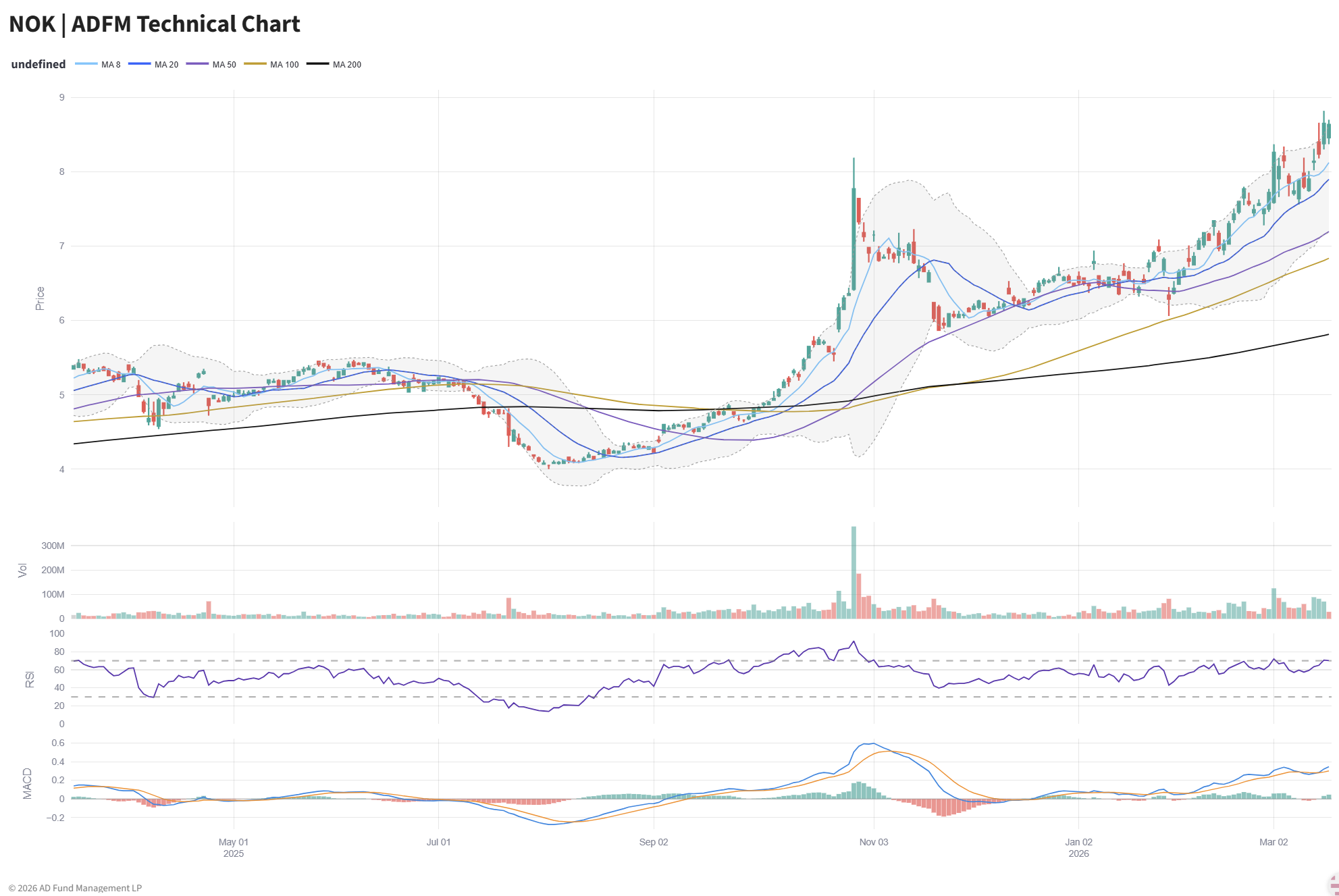
The 10-year performance is only +42%[71], reflecting how long-term holders endured a stagnant period. However, the 5-year performance of +104%[67] tells a tale of recovery: the stock basically doubled from its late-2010s lows, albeit with volatility. Notably, a portion of that 5-year gain came very recently – in the last year Nokia is +62%[71] (massively outperforming broader indices), and year-to-date 2026 it’s up ~34%[72].
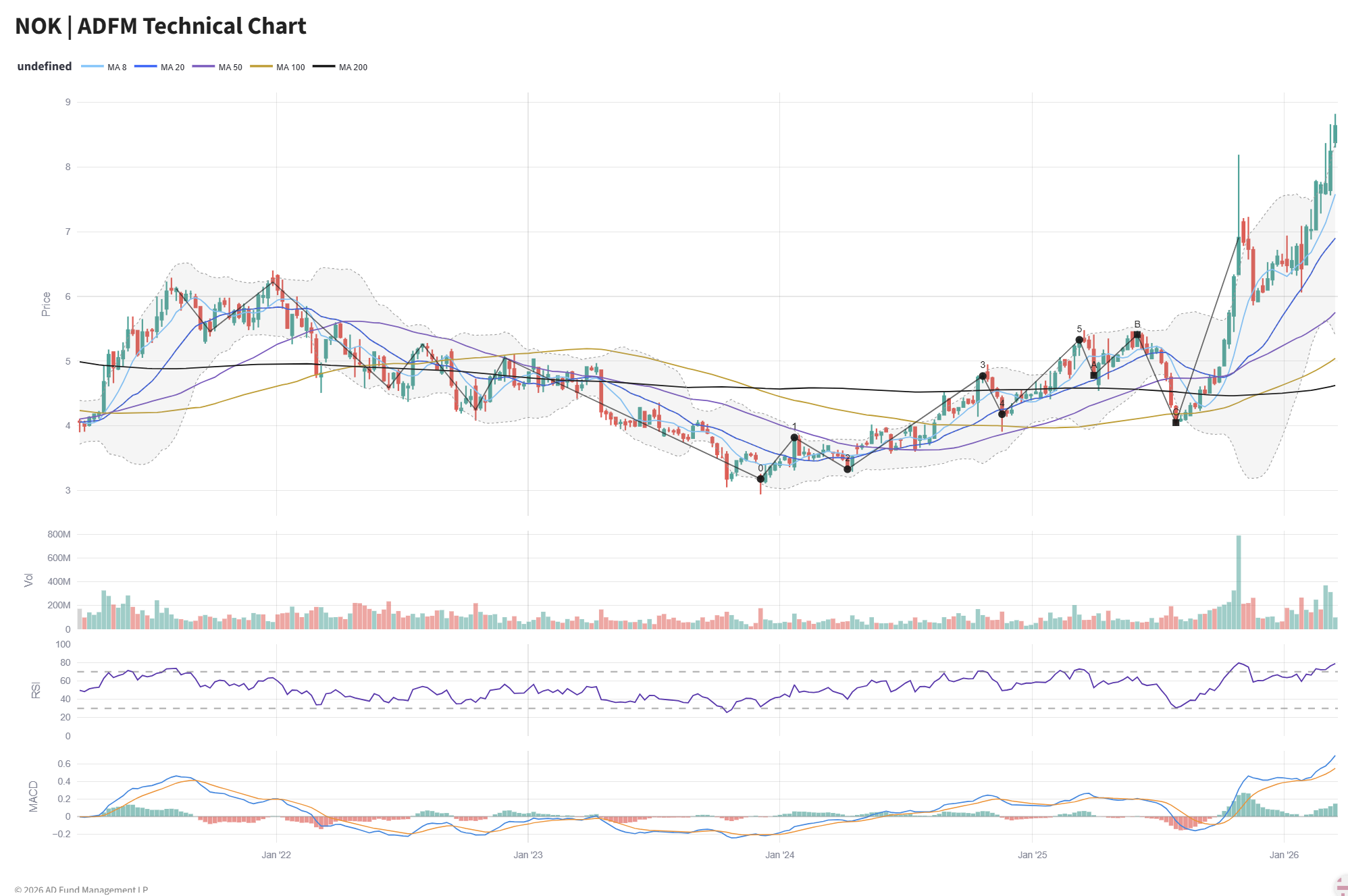
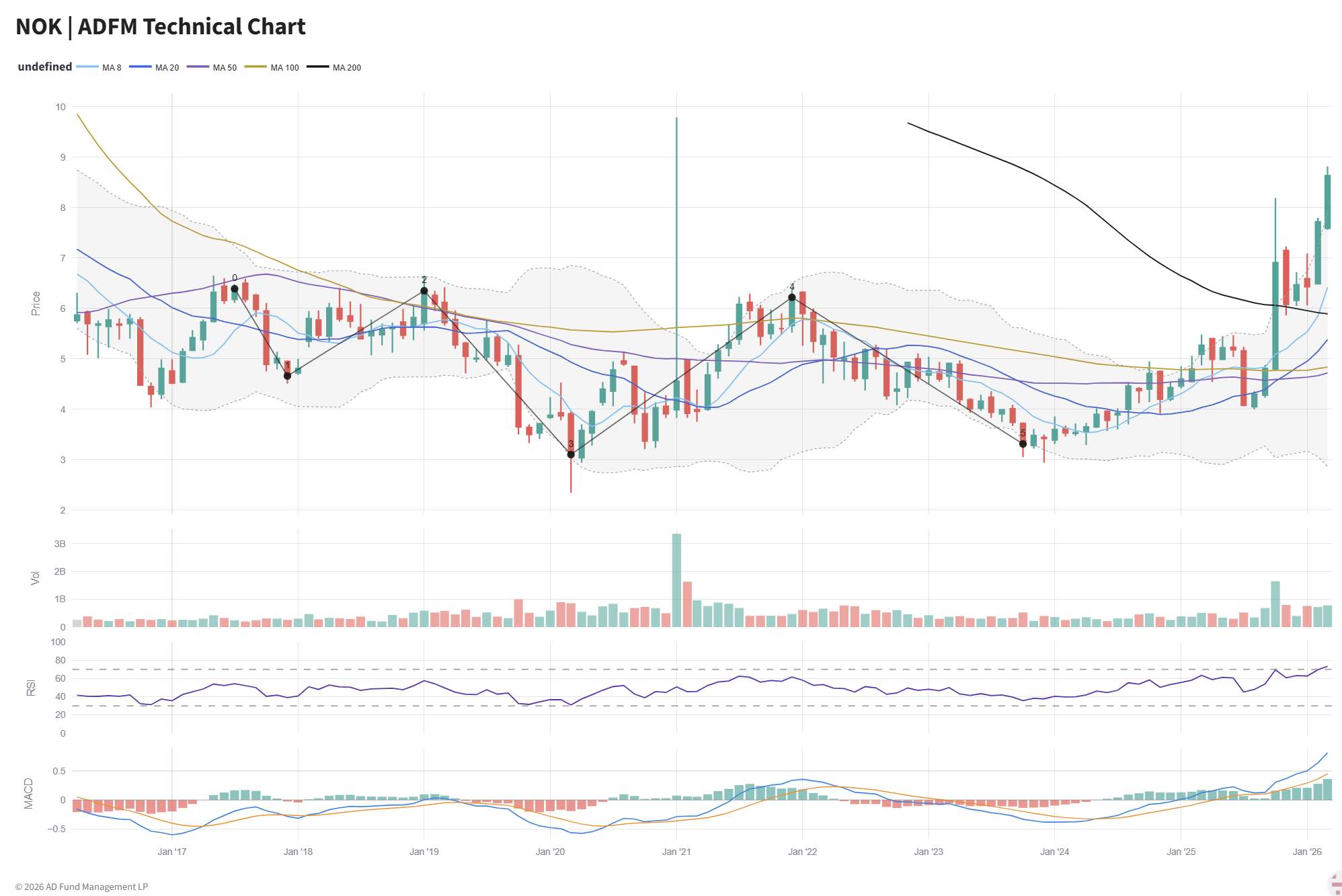
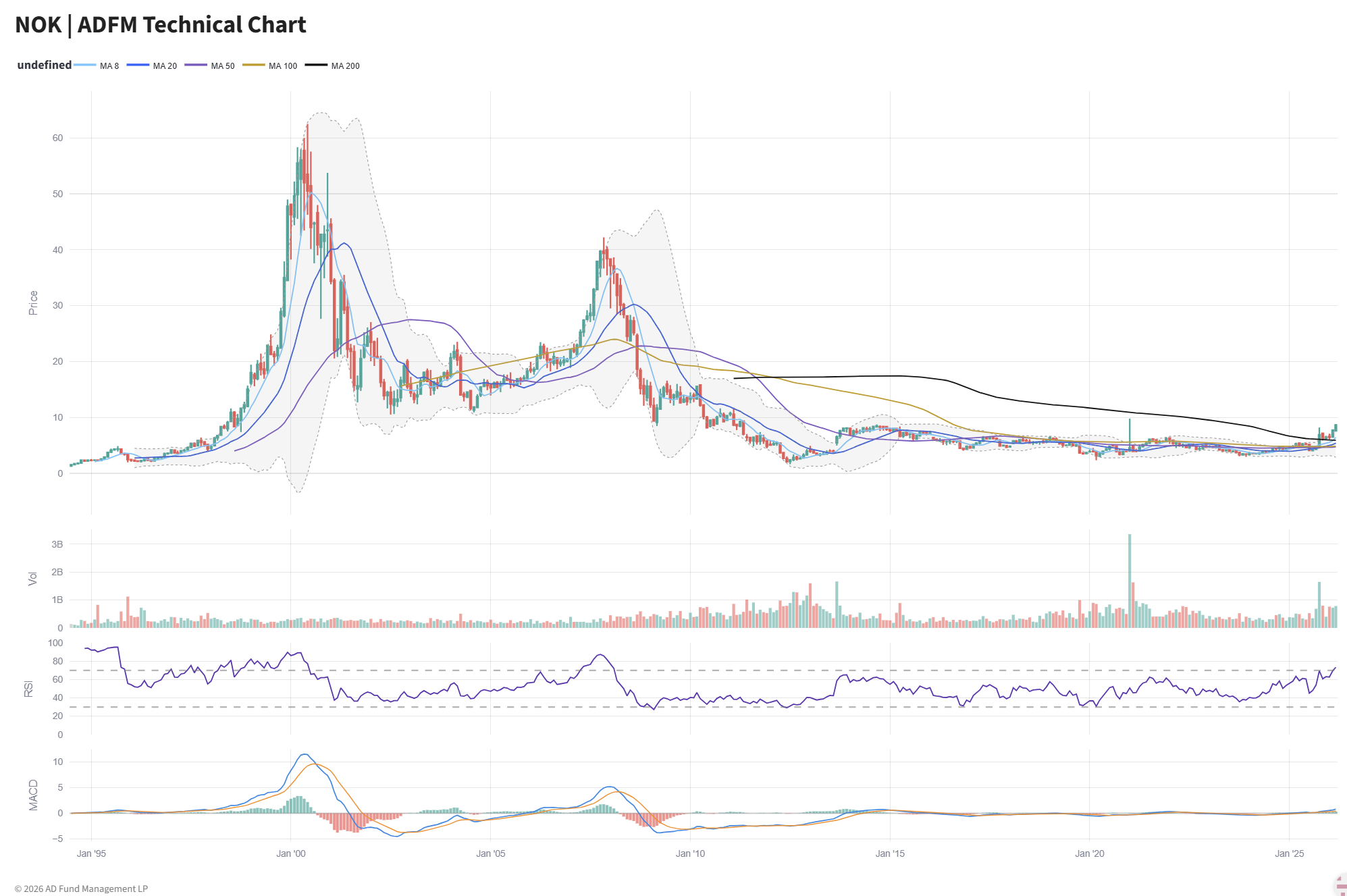
Trading ranges: The 52-week range is $4.00 – $8.66[71], so the stock is currently sitting at the top of its yearly range (around $8.6). In fact, it’s near multi-year highs – the last time Nokia sustained trading above $8 was way back around 2016. The early 2021 spike during the Reddit-fueled rally briefly touched these levels but was not sustained (and was on anomalous volume). The difference now is Nokia reached ~$8.6 on the back of fundamentals (earnings beats, guidance, strategic pivot) and strong volume, rather than purely speculative frenzy, which lends credence to this breakout.
Resistance levels: The $8.50-$9 zone is a clear resistance band, as evidenced by multiple peaks. If Nokia convincingly pushes past ~$9, it would mark a multi-year high breakout, potentially triggering technical buying (and some short covering, though short interest is low ~0.7% float[73]). Above $9, the next psychological level is $10 (which it hasn’t seen in a decade-plus on ADR).
Support levels: On the downside, $7.50 (roughly where Morgan Stanley recently set an $8 target[74]) might act as initial support (it was a minor consolidation point during the climb). More solid support likely sits around $6.00–$6.50 (the prior ceiling which could become a floor, and near the 2025 highs before the Q4 spike). And then $4–$5 was a long-term floor where value buyers stepped in historically (the 52-week low being $4.00[75]).
Trend and momentum: Nokia’s 200-day moving average has turned up sharply; the stock is ~49% above its 200-day SMA[76], confirming a strong uptrend. The 14-day RSI is about 70 (recently hit ~70.7)[77], which is around the threshold of “overbought.” This suggests the stock’s rapid ascent might consolidate or pull back in the very near term – a healthy pause could be expected after such a run.
In technical terms, Nokia has broken out of a multi-year base. It spent a long time bottoming out in that $3–5 range from 2018 to 2020. The breakout above $6 in late 2025, and then above $8 in early 2026, likely indicates a trend reversal into a bull phase. This is supported by volume confirmation (heavy buying volume on up days around earnings and Capital Markets Day news). The long-term trend (monthly) now looks positive for the first time in ages: higher highs and higher lows are being established on the chart.
One consideration: around current levels, some technical traders might take profit given the stock nearly doubled in 6 months. Indeed, Arete Research just downgraded Nokia to Neutral purely on valuation after the rally[81], which could introduce some churn. But if Nokia continues to deliver improving fundamentals, any dips might be bought, given the newfound interest from institutional investors repositioning into the name.
Historical perspective: If we go way back, Nokia was once a $40-50 ADR in its cellphone heyday (2007). Of course, that’s not relevant now, but it’s a reminder that legacy holders who bought a decade ago are still way underwater. Many of those might have exited; the current shareholder base likely includes more value and event-driven funds who got in around 2020–2022. The technical implication is that overhead supply from old shareholders is less of an issue now; the stock’s float has largely turned over.
Key Drivers (6–12 Months)
In the next year (2026 into early 2027), several catalysts and drivers could impact Nokia’s performance and share price:
European 5G Swap-Outs (Huawei Ban Enforcement): Perhaps the most immediate catalyst is regulatory. The EU’s push to ban or phase out Chinese 5G gear is expected to accelerate in late 2026. As this moves from policy to action, European carriers (in Germany, Italy, etc.) will be issuing RFPs to replace Huawei equipment. Nokia is in prime position to win a good chunk of this business alongside Ericsson. We will likely hear announcements of Nokia securing sizable contracts as a result. Each such win (e.g., if Vodafone or Deutsche Telekom selects Nokia to swap 5G radios in X number of cities) can boost revenue forecasts. The company has guided that Huawei’s EU market share (worth €2–2.5B annually) is an opportunity[7] – even capturing half of that over a couple of years would be material. So, as 2026 progresses, news of contract awards in Europe will be a stock driver.
North American Market Stabilization: In recent quarters, North America (especially the U.S.) was weak for Nokia due to a pause in 5G deployment and earlier share loss. A key driver ahead would be any sign of recovery or share regain in the U.S. market. For instance, Verizon and AT&T have largely completed initial 5G builds; if they resume spending on next phases (5G expansion, 5G Advanced) in late 2026, Nokia could see orders flow. Also, Nokia has been working to diversify in North America by selling to enterprise and cloud customers – any notable deal (say, Nokia providing a private 5G network to a large tech company’s campus, or supplying routers to a hyperscaler) could be a catalyst. The Morgan Stanley upgrade in Jan 2026 to Overweight suggests some expect an inflection in the U.S. business. Watch for commentary in earnings calls about North America picking up.
Cost Reduction Execution: Nokia has laid out new cost-saving plans (streamlining to two segments, reducing overhead). In the next 2-3 quarters, evidence that these savings are hitting the bottom line can drive upside. For example, if by Q2 or Q3 2026 Nokia’s SG&A and common costs are visibly lower, margins could beat expectations. The company already announced headcount cuts of 5-10k; seeing that through without disrupting sales will be key. Earnings surprises on margin improvement are a catalyst – nothing moves a stock like beating margin estimates in a cost-cut story. So each quarterly result in 2026 where Nokia can show incremental op margin uptick (even 1–2 pts) will build confidence.
Product Cycles & Launches: On the technology front, Nokia will be rolling out new products: e.g., their next-generation 5G chipsets (ReefShark) which reduce power and improve performance, new 6G prototypes and trials (6G research is heating up; Nokia might demo some capabilities in 2026–27), and network software updates (like cloud-native core software releases). If any of these products gain traction or win industry accolades, it can be a commercial driver. A specific example: Nokia is expected to introduce more vRAN (virtualized RAN) solutions – if they can show progress in Open RAN deployments, it could open new customer doors (especially in markets like India where Open RAN interest is high). Also, Nokia Bell Labs may showcase breakthroughs (they often do so at events like Mobile World Congress); these won’t translate immediately to revenue but reinforce the narrative of Nokia as a tech leader, which helps sentiment.
Customer CapEx Cycle: We should monitor the capital spending plans of key telcos. Many operators cut spending in 2024 due to macroeconomic concerns. Any guidance updates from, say, Verizon, AT&T, Vodafone, etc., indicating a return to investment in late 2026 could signal more orders for Nokia. For example, if AT&T decides to expand fiber (benefiting Fixed Networks) or T-Mobile invests in 5G standalone core (benefiting Cloud/Network Services), Nokia stands to benefit as a supplier. These things often get hinted at in carrier earnings or industry reports mid-year.
Portfolio Moves (M&A or Divestitures): Nokia is evaluating some non-core units (placed into “Portfolio Businesses”)[82]. In the next year, Nokia might decide to sell or shut down one of those low-margin units (e.g., Fixed Wireless Access CPE gear, or certain services operations). A sale could bring a small cash inflow and margin uplift (by exiting a loss-making unit). While these are not huge parts of Nokia (Portfolio Businesses had <5% of sales and a -€90M op loss in 2025[83][84]), any divestiture news would signal management’s commitment to focus on profitable areas and could be taken positively by the market. On the M&A front, integration of the Infinera optical business (acquired 2025) is ongoing – updates that this integration is ahead of schedule (yielding cross-sales or cost synergies sooner) would be a mini-catalyst.
Investor Day / Capital Markets Communications: Nokia just had a Capital Markets Day in late 2025, so the next one might be 2027 or so. But interim, if Nokia hits milestones, management might update long-term guidance or capital allocation plans. For instance, if by late 2026 FCF is strong, they might announce an incremental share buyback or dividend hike. Also, keeping an eye on analyst upgrades – as the story improves, more analysts could shift to buy (already saw JP Morgan, MS upgrades). This can gradually push the stock as well.
Reflexivity and Sentiment: As the stock price has strong momentum, there’s a reflexive element: a rising stock draws in more investors (performance chasing by funds, inclusion in momentum portfolios, etc.). Nokia’s break above $8 has put it on radar for many who ignored it at $4. If it continues to perform, near-term sentiment could carry it higher than fundamentals alone would suggest, at least temporarily. We’ll watch technical indicators like volume and any unusual options activity as clues to short-term moves.
In summary, the next 6-12 months for Nokia will likely be driven by deal wins (especially Huawei-replacement deals in Europe), margin execution, and the broader trend in telco/capex spending. The good news is that many of these drivers have a positive skew given where we are in the cycle (post-downturn). The main thing to monitor is whether those expected drivers materialize on schedule. If Nokia prints a couple of strong quarters in 2026 (showing even slight growth and margin uptick) and announces a few big contract wins, the stock’s recent momentum could be sustained.
Risks and Reversals
No investment comes without risks, and Nokia has several that could thwart our bullish thesis. Key risks include:
Prolonged Telecom Capex Slump: A core assumption is that carrier spending will stabilize or improve. But what if it doesn’t? Industry analysts at Omdia project essentially flat RAN market until around 2030 (when 6G kicks in)[12]. If carriers continue to hold back investments (due to high debt loads, lack of new revenue streams, or macro recessions), Nokia’s revenue growth could stall or even decline. A scenario where 5G investment has largely peaked and 6G is still far off would mean Nokia’s main business might stagnate for years. In such a case, our variant of above-consensus growth fails – Nokia would be stuck fighting for market share in a no-growth pie. This is arguably the biggest risk: the industry cycle might simply be against Nokia in the near term. If telco budgets stay tight (perhaps because operators are awaiting new monetization like enterprise 5G which is slow to come), then Nokia’s rosy scenarios won’t play out.
Competitive Pressure & Market Share Loss: Nokia operates in hyper-competitive markets. Ericsson remains a formidable rival, often undercutting on price to win deals. There’s risk that Nokia could lose further RAN share, especially in markets like India or Latin America, to aggressive pricing by competitors (including Samsung, which secured a major Verizon contract at Nokia’s expense earlier, or even new Open RAN vendors). If Nokia’s products lag in performance or cost, carriers won’t hesitate to shift vendors. For instance, Nokia’s mobile networks margin woes in 2025 partly reflect that it had to cut prices or lost high-margin deals, whereas Ericsson’s comparable margin was much healthier[14]. Continued underperformance here would break the thesis of margin recovery. Another angle: Chinese vendors, while banned in some places, are still active in others (Asia, Middle East, Africa). Huawei could double down on those regions with cutthroat pricing to compensate for Europe, potentially squeezing Nokia’s emerging markets business. There’s also a tail-risk that political stances change – e.g., if some European countries delay or resist the Huawei ban after all, Nokia’s anticipated market share gains might not materialize as expected.
Execution Risks (Restructuring and R&D): Nokia is in the midst of a significant internal reorganization – folding divisions, changing leadership (new CEO and several new top execs in late 2025[5][85]), and cutting costs. Execution missteps here could hurt. For example, morale or focus could dip during restructuring, leading to project delays or weaker customer support. If the integration of Mobile Networks, Cloud, and Nokia Tech into one Mobile Infra unit causes disruption or distraction, Nokia might fumble in responding to customer needs. Similarly, integration of acquisitions (Infinera’s optical biz) carries risk – cultural mismatch or loss of key talent could erode the expected gains. On the R&D side, technological execution risk is key: Nokia must keep up in silicon development (its system-on-chip for 5G has sometimes lagged Huawei’s and Ericsson’s custom chips). If Nokia’s next-gen chips or its software-defined products underperform or are delayed, it cedes ground. With 6G on the horizon, a wrong bet in R&D (investing in a technology that doesn’t pan out) could leave Nokia behind when that cycle arrives.
Margins and Cost Inflation: Our thesis assumes margins will improve, but risks could pressure margins instead. Inflation in component costs or supply chain (e.g., if chip prices rise, or supply shortages force expensive procurement) can hurt Nokia, which operates on fairly slim margins. Also, wage inflation – Nokia employs thousands of engineers; rising labor costs in key centers (Finland, India, etc.) could increase R&D expense. If Nokia cannot pass costs to customers due to competitive pricing, margins compress. Another factor: currency fluctuations. A significant portion of Nokia’s cost base is euro and dollar, while revenues are global. If the euro were to strengthen a lot against currencies of key customers (say, against emerging market currencies or even USD to some extent), Nokia’s products effectively become more expensive abroad or its reported profits shrink when converting foreign sales to euros. FX cuts both ways: a strong euro is a margin headwind (and a risk for the ADR since fewer EUR translate to USD profit).
Geopolitical and Regulatory Risks: While Nokia benefits from Huawei’s troubles, geopolitics can also hurt it. One nightmare scenario (as highlighted by a Wall Street Journal report) is if the US-China tech war escalates such that the US restricts exports of critical tech to Europe or Nokia[86]. Nokia relies on some American technology (advanced semiconductors, software tools). If, say, the US were to bar certain chip sales to Nokia’s European operations (not likely but conceivable in a tit-for-tat trade war), that’d cripple Nokia’s supply chain. Or if China retaliated by making life hard for Nokia in China – Nokia still has a presence in China (though small share, it sells to China Mobile etc. to some extent). A more realistic geopolitical risk: some countries might try to nurture new local competitors (India, for instance, has shown interest in developing domestic 5G alternatives). If a credible new competitor arises supported by government (like India’s Jio is working with local vendors for 5G), Nokia could lose out in those markets.
Patent Litigation or Fee Compression: Nokia’s high-margin licensing business could face risk from legal or regulatory fronts. There’s a broader trend of regulators scrutinizing patent licensing for fair terms. If major licensees (like Apple, Samsung) push back during renewals to lower royalty rates, Nokia’s licensing income could decline. Or if Nokia got into a protracted patent litigation (like it did with Lenovo or Apple in the past), legal costs could rise and royalty streams be delayed. EU or US regulators could also potentially cap royalties for standard-essential patents (a topic of debate). Since licensing profits are disproportionately important, any hit here directly reduces EPS and cash flow.
Client Risk and Concentration: Large operators account for meaningful chunks of Nokia’s revenue. A loss of a single big customer contract (say, if Verizon or a major European group decided to switch primarily to Ericsson or Samsung) would be a blow. Similarly, consolidation in telecom (like if two customer companies merge and cut duplicate spending) can reduce Nokia’s addressable market. For instance, the potential merger of Vodafone and Three in the UK could lead the combined entity to streamline vendors (maybe dropping one – if it’s Nokia, that’s a risk).
Global Recession / Macro Shock: A severe global recession in 2026–27 could force enterprises to delay network upgrades and governments to tighten telecom investment. Telcos might prioritize dividends/debt reduction over capex if credit conditions worsen. Also, emerging market currency crises (if those operators can’t afford imported equipment) could hurt orders. While communications is somewhat defensive, big projects can be deferred in downturns.
Sentiment and Reflexivity (the other way): The stock has run up, so there’s a risk of a pullback. If Nokia hits any stumbling block, the market could swiftly punish it given the recent optimism. For example, if the next earnings show an unexpected decline or weak guidance, the narrative could flip back to “here we go again, Nokia can’t execute,” causing a sharp correction. The wide dispersion in analyst opinions earlier[87] suggests if evidence supports the bear case, those negative voices will amplify.
Any of these risks, if they materialize, could reverse the positive momentum and lead us to re-evaluate the thesis. Particularly, a combination of slower revenue and persistent margin pressures would essentially lock Nokia into the “value trap” category – cheap for a reason. As investors, we will watch these potential thesis-breakers closely. We have some mitigants (e.g., the balance sheet strength helps buffer against shocks, and diversification of customers mitigates any one client risk somewhat), but they do not eliminate the risks.
In summary, while we are optimistic, we acknowledge Nokia must thread the needle: the company needs a cooperative industry environment and flawless execution to meet targets. A significant deviation on any of those fronts (demand, competition, execution, or external factors) could derail the investment case. Keeping an eye on early warning signs – like declining book-to-bill, margin misses, or any major negative news on the Huawei ban front – will be crucial for risk management.
Conclusion
Bringing it all together, we view Nokia as a recovery and transformation story with the potential to evolve into a long-term compounder – but not without risks. At this juncture, the evidence leans toward recovery trade rather than value trap. The company’s recent results and actions signal a positive inflection: returning to growth (albeit modest), refocusing on higher-margin opportunities, and benefitting from external tailwinds (like Western markets favoring Nokia over untrusted rivals)[7][88]. The stock’s strong rally off multiyear lows reflects the market starting to price in this improved outlook, yet the valuation remains reasonable and not fully reflective of a successful turnaround.
Nokia today is not the bloated, directionless firm of five years ago – it has a clear strategic vision (AI-era networks), a new leadership team executing decisive changes, and tangible opportunities to grab share and expand margins. This puts it firmly in the category of a recovery trade: an asset that was maligned and undervalued, now re-rating as fundamentals improve. We’ve seen encouraging “green shoots” in the form of segment growth (optical, software) and a return to in-line or better earnings delivery[89][27]. Importantly, Nokia’s balance sheet and dividend provide downside cushion, which is atypical for a pure growth story – another indicator that this is a classic recovery/value turnaround play.
Could Nokia become a long-term compounder? Possibly, if it successfully executes over the next 3-5 years. For that to happen, Nokia would need to string together several years of growth (both top-line and EPS), establish a durable competitive edge in new markets (like enterprise networking, 6G, cloud partnerships), and continue returning cash to shareholders.
It’s not yet proven it can do that – the telecom industry’s history is more cyclical than secular growth. But Nokia’s aim is indeed to pivot into a more secular growth trajectory (leveraging AI, enterprise, etc.). If those bets pay off, Nokia could graduate into the ranks of steady compounders, with a mix of mid-single-digit growth, expanding margins, and regular capital returns.